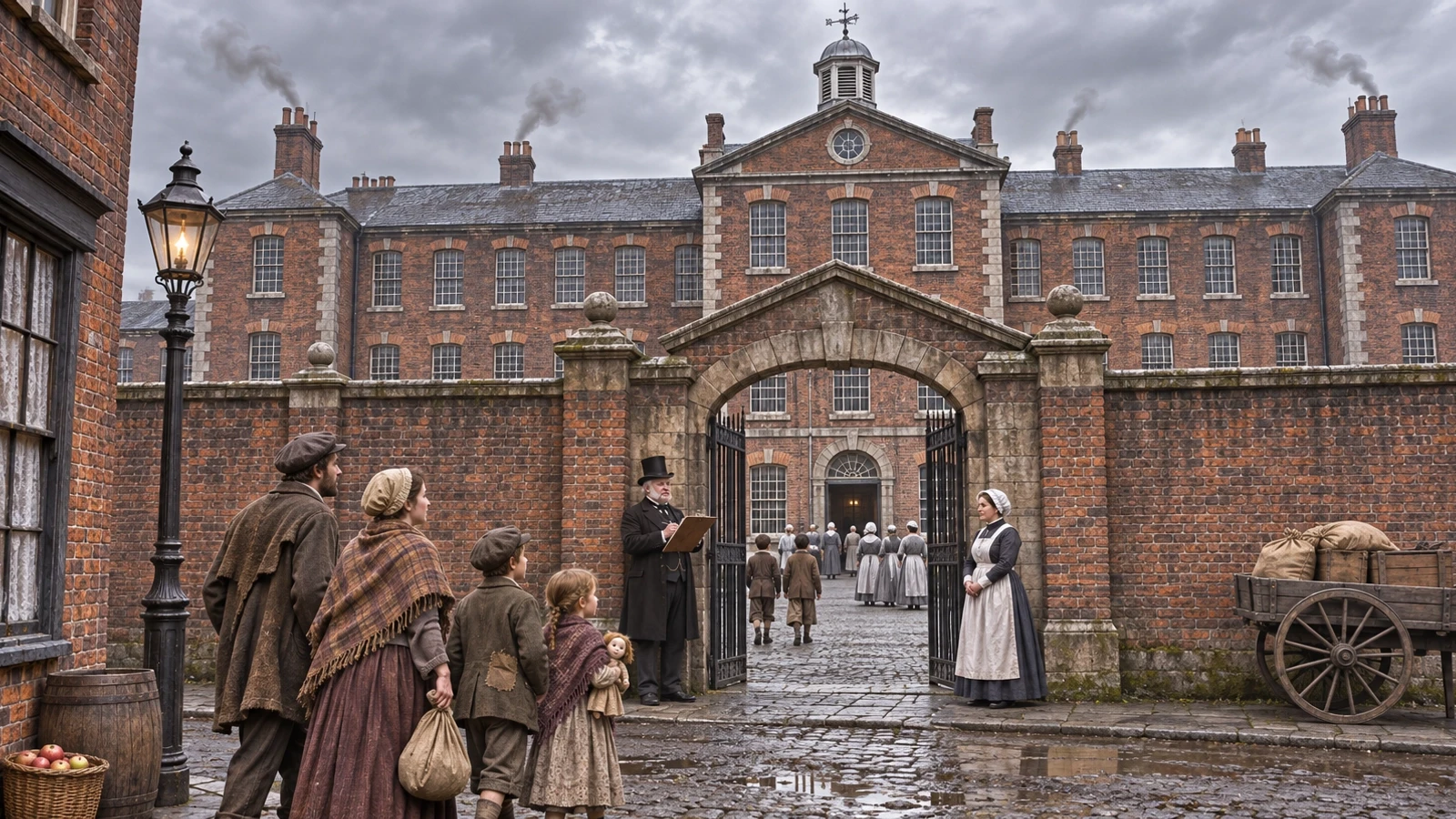
In Victorian times, there was no benefits system to help families who had no money, no job or nowhere to live. For many of the poorest people in Britain, the only place left to go was the workhouse. Workhouses gave people food and a bed β but in return, life inside was strict, hard and often very unhappy.

Victorian Workhouses for Kids ποΈ
π Why Were Workhouses Built?
Helping the poor had become very expensive, so in 1834 Parliament passed a new law called the Poor Law Amendment Act, often known as the βNew Poor Lawβ. The idea was to make the system cheaper and the same all over the country. Local areas (called parishes) were grouped together into βPoor Law Unionsβ, and each Union built its own workhouse. After this, most poor people could only get help if they went to live in a workhouse.
πͺ Arriving at the Workhouse
When people arrived, their own clothes and belongings were taken away and they were given a plain workhouse uniform made of rough, scratchy material. Families were split up β men, women and children each lived and worked in different parts of the building. Brothers, sisters and parents often only saw each other for a short time each week.
β° A Strict Daily Timetable
Life in the workhouse followed strict rules. Bells told everyone when to get up, eat, work and go to bed. Meals were plain and boring, and the same food was served again and again. People weren't allowed to come and go as they pleased, and breaking the rules could mean punishment.
πͺ’ Hard Work
Everyone who was able had to work. Women usually did cleaning, cooking, sewing and laundry. Men often did tiring jobs like breaking stones or grinding corn. One of the most common jobs was βpicking oakumβ β pulling apart old, tarry ropes into loose fibres, which were then used to seal the gaps in wooden ships. It was slow, boring work that made fingers sore, and it was often done by women and children.
Want your child to go further? Our Victorians pack has a story, magazine and activities
π§ Children in the Workhouse
Children in workhouses were separated from their parents. They were given some lessons, but they also had to work. Some children were sent out to work in factories or mines.
π Oliver Twist
One of the most famous stories about a workhouse is Oliver Twist by Charles Dickens, published in the 1830s. Oliver is an orphan who grows up in a workhouse. In one famous scene, he is so hungry that he holds up his bowl and asks, βPlease, sir, I want some more.β Dickens wrote the story partly to show readers how unfair life could be for poor children.
π What Happened to the Workhouses?
Over time, people began to see that workhouses were cruel, and new ways of helping the poor were introduced in the 1900s. Workhouses were gradually closed, and many of the buildings were used for other things. Some old workhouses are now museums you can visit, such as The Workhouse in Southwell, Nottinghamshire, run by the National Trust.
πΊοΈ Explore More Victorian History
Dive deeper into the world of the Victorians with more kid-friendly guides, printables and facts.
Take Victorian Workhouses Further
Bring Victorian history to life at home or in the classroom with our Victorians packs.
Want your child to go further? Our Victorians pack has a story, magazine and activities
Get the Victorians packTeaching Victorians? Our Victorians classroom pack has lessons, a class wall map and timeline
Get the classroom pack