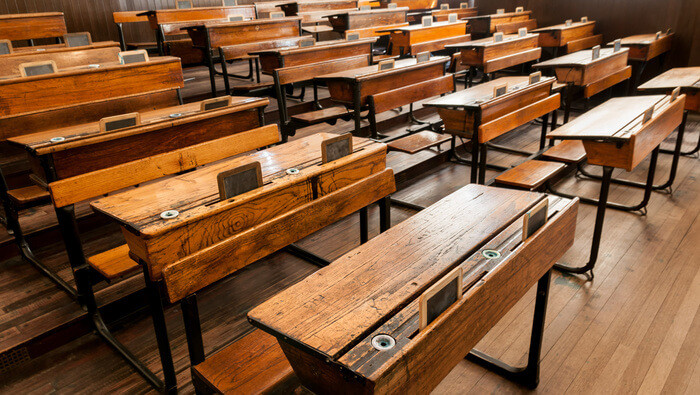
A Victorian-era classroom scene showing children seated at wooden desks, representing the strict and disciplined schooling of the nineteenth century
🏫The Victorian Era🏫

Victorian Schools for Kids

Discover how the Victorians changed education in Britain and created the school system we know today!

History Facts!

πŸ“– The Reform of Education

One of the great achievements of the Victorian Era was the reform of education. Before this time, most children did not go to school. Unlike today, when children receive free education from the government, education in earlier times was usually only available to children from wealthy families.

Because of this, many people in the past were illiterate, which means they could not read or write.

During the nineteenth century, some people began to argue that all children should have the chance to go to school. These people were known as social reformers. One of the most important was William Forster.

The Education Act!

πŸ“œ The First Education Act of 1870

Because of his efforts, the First Education Act was passed by the British Parliament in 1870. This law required local areas to receive government funding to create schools. These schools allowed children between the ages of five and thirteen to learn important skills such as reading and writing, no matter their family's background or how much money their parents had.

More laws were passed in the following years, which helped make education more widely available. By the end of the Victorian Era, these changes had helped create the modern school system that we recognise today.

Key Changes

  • 🏫New Schools Built β€” Local areas received government funding to create schools for all children
  • πŸ‘§Ages 5 to 13 β€” Children in this age range could now attend school
  • πŸ“–Reading and Writing β€” Important skills were taught to all children regardless of background
  • βš–οΈMore Laws Followed β€” Further acts made education even more widely available

Life at School!

πŸ”” A Day at a Victorian School

Victorian schools were very strict places for children, and the school day was long and disciplined. Many schools had separate entrances for boys and girls, and the classes were often very crowded, sometimes with 40 to 60 pupils in one room.

Lessons usually began early in the morning and continued until late afternoon, with reading, writing and arithmetic being the main subjects. Instead of exercise books, many children wrote on slates with slate pencils so their work could be wiped off and reused. The teacher stood at the front of the class and pupils were expected to sit quietly, listen carefully and repeat lessons out loud.

Inside a Victorian Classroom

  • πŸšͺSeparate Entrances β€” Boys and girls often entered the school through different doors
  • πŸ‘¨β€πŸ‘©β€πŸ‘§β€πŸ‘¦Crowded Classes β€” Up to 40 or 60 children packed into a single room
  • πŸͺ¨Slates and Slate Pencils β€” Children wrote on slates instead of paper so work could be wiped off and reused
  • πŸ”’The Three Rs β€” Reading, writing and arithmetic were the main subjects taught

Strict Rules!

πŸ“ Discipline in the Classroom

Discipline was extremely strict in Victorian classrooms. If children misbehaved or did their work badly, they could be punished. One common punishment was wearing a dunce hat, which was meant to embarrass the child in front of the class.

Teachers also used the cane to hit children on the hand as a punishment for mistakes or bad behaviour. Because classrooms were so crowded and teachers believed in strict order, punishments were often used to keep children quiet and obedient.

Victorian Punishments

  • 🎩The Dunce Hat β€” A pointed hat worn to embarrass misbehaving children in front of the class
  • πŸͺ΅The Cane β€” Teachers could hit children on the hand for mistakes or bad behaviour
  • 🀐Silence at All Times β€” Pupils were expected to sit quietly and obey every instruction

Schools for All!

🀝 Ragged Schools

Ragged schools were very different from ordinary Victorian schools. They were set up to educate very poor children who could not afford to go to normal schools. These schools were usually free and were often run by charities and volunteers.

Children at ragged schools were taught basic reading, writing and sometimes practical skills, and they might also receive food or clothing. For many poor children in Victorian cities, ragged schools were the only chance they had to learn and improve their lives.

What Made Ragged Schools Special

  • πŸ’°Free to Attend β€” No fees were charged, so even the poorest children could come
  • 🀲Run by Volunteers β€” Charities and kind-hearted people gave their time to teach
  • 🍞Food and Clothing β€” Some children received meals or clothes as well as lessons
  • πŸ”§Practical Skills β€” Alongside reading and writing, children sometimes learned useful trades

Mysteries in Time
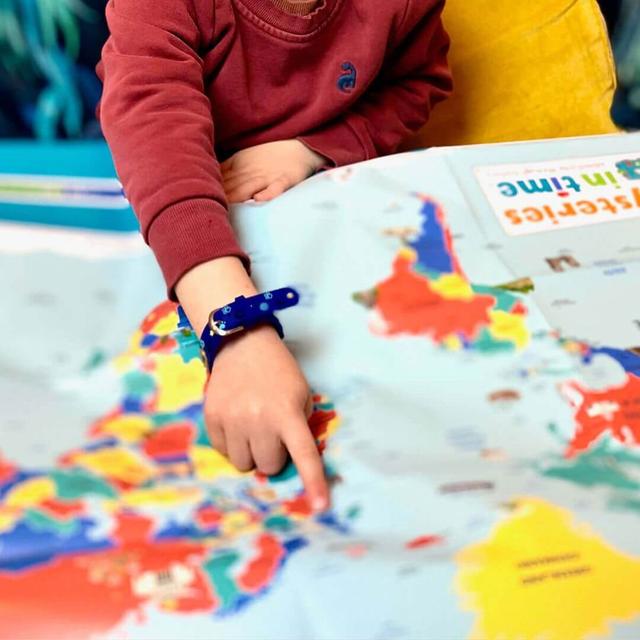
Mysteries in Time history activities for kids featuring an illustrated world map with historical landmarks

History Subscription Box for Kids

Bring History to Life β€” One Mystery at a Time

Turn history into an adventure! Stories, magazines, puzzles, crafts and hands-on fun β€” delivered straight to your door every month.

Loved by kids & parents
New era every month
Puzzles & activities
Start Your AdventureSkip or cancel anytime

As Seen In

Junior Magazine
Little London
Made for Mums
Mail Online
The Guardian
USA Today