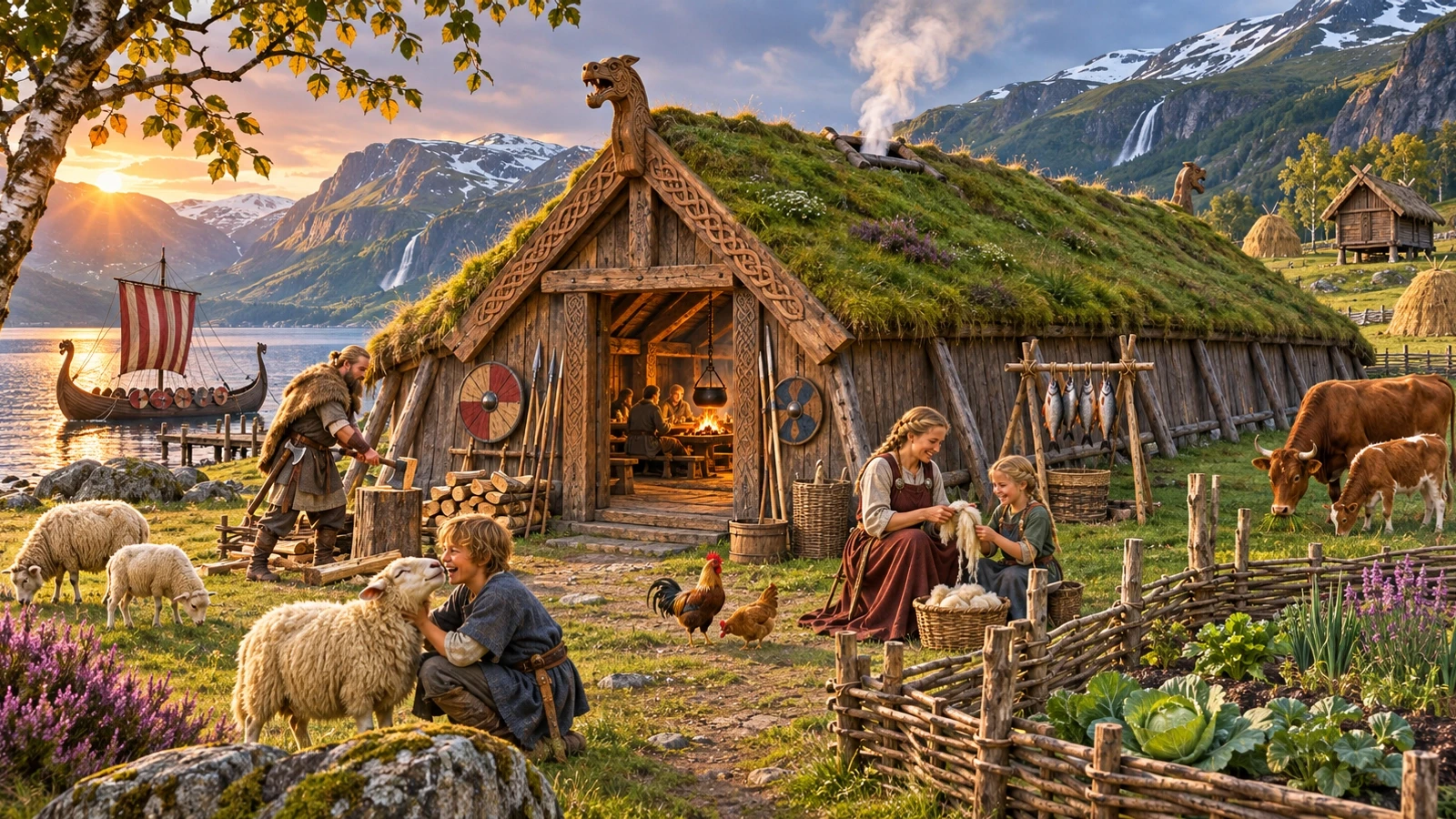
When we think of Vikings, we often picture fierce warriors sailing longships. But most Vikings spent their days at home on the farm. So what were Viking houses like? Most Viking families lived in a long, narrow building called a longhouse β and life inside was cosy, crowded and very smoky!

Viking Houses for Kids π π₯
πͺ΅ What Was a Longhouse?
A longhouse was a long, narrow home, usually built on a farm. It had a strong wooden frame standing on simple stone foundations. Two rows of wooden posts ran down the inside to hold up the heavy roof. The walls often bowed outwards in the middle, so from above the house was wider in the centre than at the ends β a bit like the shape of a ship!
π§± What Were Viking Houses Made Of?
Vikings built with whatever was nearby:
- Walls of wooden planks, logs, or βwattle and daubβ β woven sticks covered in sticky mud and clay
- Roofs of wood, straw thatch, or turf (squares of grass and soil)
- In places with few trees, like Iceland, they built thick walls from turf, which kept the heat in brilliantly
- Floors were made of packed-down earth, sometimes covered with rushes
π₯ Inside a Viking Longhouse
The heart of every longhouse was a fire in the middle of the floor. It was used for cooking, warmth and light. There was no chimney, so smoke had to drift out through a hole in the roof β which meant the house was often very smoky! Wooden benches ran along the walls, and families sat on them by day and slept on them at night. For extra light, Vikings burned oil (often fish oil) in simple lamps.
Want your child to go further? Our Vikings pack has a story, magazine and activities
π Sharing a Home with Animals
In winter, many Viking families kept their cows, sheep and other animals inside the longhouse, in a separate section at one end. The animals were safe from the cold, and their body heat helped keep the whole house warmer. It must have been smelly β but it was practical!
π¨βπ©βπ§βπ¦ Daily Life at Home
A longhouse was a busy place. Sometimes several families or relatives lived together under one roof. Everyone had jobs to do: looking after animals, farming the land, cooking in iron pots over the fire, and spinning, weaving and sewing cloth to make clothes. Children helped with chores from a young age.
ποΈ Viking Villages
Longhouses were often grouped together into small villages of a few farms, sometimes surrounded by a fence. Many farms also had smaller buildings for storage or workshops. In towns, houses were usually smaller and packed closely together.
βοΈ Make Your Own Longhouse
Use a shoebox to make a model Viking longhouse! Cover the roof with green paper or real grass cuttings to make a turf roof, draw on wooden planks, and make a small fire from red and orange tissue paper in the middle. Don't forget to add some animals at one end!
πΊοΈ Explore More Viking History
Dive deeper into the world of the Vikings with more kid-friendly guides, printables and facts.
Take Viking Houses Further
Bring Viking history to life at home or in the classroom with our Vikings packs.
Want your child to go further? Our Vikings pack has a story, magazine and activities
Get the Vikings packTeaching Vikings? Our Vikings classroom pack has lessons, a class wall map and timeline
Get the classroom pack