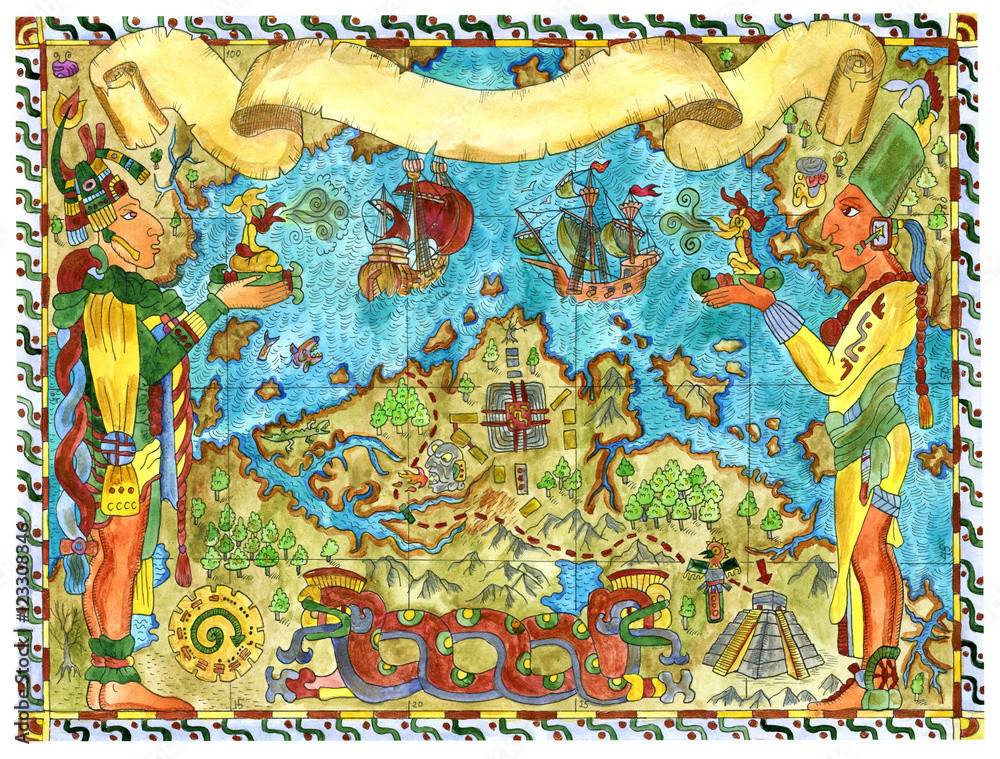
An ancient Mesoamerican pyramid evoking the great Aztec city of Tenochtitlan, the capital of the Aztec Empire on Lake Texcoco
πŸ›οΈThe Aztec EmpireπŸ›οΈ

Tenochtitlan for Kids πŸ¦…πŸŒ΅

Aztec History!

The Aztec City on the Lake

Imagine a city built in the middle of a lake, with canoes gliding along canals instead of cars on roads. That was Tenochtitlan, the amazing capital city of the Aztecs. For around 200 years it was one of the biggest and busiest cities in the world.

Today, one of the largest cities on Earth, Mexico City, stands on the very same spot. Discover how the Aztecs built a city on water, fed it with floating gardens and ruled a great empire from its temples and palaces.


A Legendary Sign!

πŸ¦… The Legend of the Eagle and the Cactus

The Aztecs, who called themselves the Mexica, wandered for many years looking for a new home.

According to their legend, their god Huitzilopochtli told them to look for a special sign: an eagle perched on a cactus, eating a snake. When they finally saw it on a small, marshy island in Lake Texcoco, they knew they had found the place.

They founded Tenochtitlan there in about 1325.

πŸŒΌβœ¦πŸ’€βœ¦πŸŒΌ

Brilliant Engineers!

🏝️ Building a City on Water

Building on a swampy island wasn't easy, but the Aztecs were brilliant engineers.

They started on small islands and made the city bigger by creating new land in the lake. Over time, Tenochtitlan grew to cover more than 13 square kilometres (over 5 square miles).

To get to and from the mainland, the Aztecs built three long causeways – raised roads across the water. The causeways had gaps crossed by wooden bridges that could be taken away, which made the city easy to defend from attackers.


Clever Farmers!

🌽 Floating Gardens: The Chinampas

How do you feed a city on a lake?

The Aztecs built chinampas – small, man-made islands made from layers of mud, plants and soil, held in place by fences of woven branches. These "floating gardens" were incredibly fertile.

Farmers grew maize (corn), beans, squash, chillies and flowers on them, and kept the soil rich by scooping fresh mud from the lake bottom. Chinampas are still used in parts of Mexico City today.


Like Venice!

🚣 Canals, Causeways and Clean Water

Tenochtitlan had straight streets and a network of canals, and people often travelled by canoe – a bit like Venice!

Because the lake water was too salty to drink, the Aztecs built an aqueduct to carry fresh water into the city from springs at Chapultepec, on the mainland.

πŸŒΌβœ¦πŸ’€βœ¦πŸŒΌ

Heart of the City!

πŸ›οΈ The Great Temple

At the heart of the city stood the Templo Mayor, or Great Temple – a huge stepped pyramid with two temples at the top.

Around it were palaces, more temples and big open plazas where people gathered for festivals. Tenochtitlan also had a twin city, Tlatelolco, just to the north, which grew alongside it.


Capital of an Empire!

πŸ‘‘ Capital of an Empire

In the 1400s, Tenochtitlan joined forces with two nearby cities, Texcoco and Tlacopan.

Together they controlled a large empire across central Mexico, and Tenochtitlan became its capital. People there spoke Nahuatl, a language still spoken by more than a million people in Mexico today.


1519 – 1521

βš”οΈ The End of Tenochtitlan

In 1519, Spanish explorers led by HernΓ‘n CortΓ©s arrived.

They were amazed by what they saw – some said it was grander than any city in Europe. But in 1521, after a long siege, the Spanish and their local allies captured the city.

The Spanish built a new city on its ruins, and over the following centuries Lake Texcoco was drained. That city became Mexico City.

πŸŒΌβœ¦πŸ’€βœ¦πŸŒΌ


Take Tenochtitlan Further

Bring the Aztec city on the lake to life at home or in the classroom with our Aztecs packs.

At home

Want your child to go further? Our Aztecs pack has a story, magazine and activities

Get the Aztecs pack
In the classroom

Teaching Aztecs? Our Aztecs classroom pack has lessons, a class wall map and timeline

Get the classroom pack
πŸŒΌβœ¦πŸ’€βœ¦πŸŒΌ

Teaching this at home? Explore our secular homeschool history curriculum for ages 6–11.